
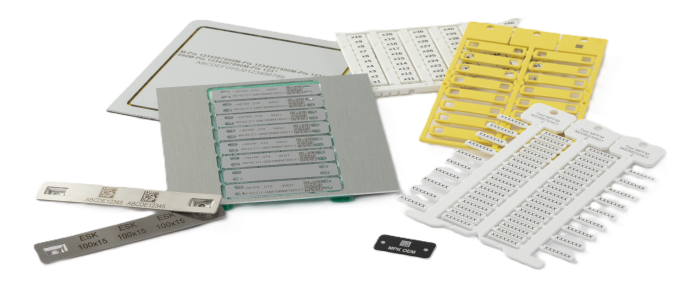
Industrial cables - Wire tagging
Clear and reliable wire identification is a critical requirement during the assembly, testing and maintenance of electrical panels and complex electrical systems. In civil buildings, industrial machinery, rolling stock, marine and offshore installations, poorly identified wires can lead to errors, delays and costly rework. This case study focuses on the challenge of wire tagging during panel assembly and shows how laser marking technology enables precise, durable and on-demand identification of individual conductors, improving efficiency, accuracy and long-term traceability without consumables.
The Challenge
Wire tagging takes place at one of the most delicate stages of the electrical workflow: panel wiring and system assembly. Operators must follow complex electrical schematics while working under time pressure, often in dense and confined wiring environments.
Key challenges:
- Complex identification needs: each wire must be clearly identified at one or both ends, often with alphanumeric codes, functional references or connection points derived from the electrical diagram.
- Time-consuming wiring operations: manually identifying and rechecking wires slows down assembly and increases the risk of human error.
- Limited space: tags must remain readable on thin conductors, tightly bundled cable harnesses or inside crowded electrical cabinets.
- Harsh operating conditions: tags must resist abrasion, bending, oils, solvents, vibration and temperature variations over the system’s lifetime.
- Long-term legibility: markings must remain readable years after installation to support troubleshooting, retrofits and maintenance.
- Consistency between documentation and reality: wire tags must accurately reflect the electrical schematic to avoid discrepancies during commissioning and service.
- Cost and logistics constraints: pre-printed markers or consumable-based printing systems add complexity, waste and downtime.
The Solution
Laser marking technology applied to wire tags and sleeves provides a precise, permanent and flexible solution for wire identification across a wide range of applications. By creating high-contrast, indelible markings on marker sleeves, wrap-around tags or dedicated wire identification materials, the laser ensures that each conductor is clearly and permanently identified.
How the solution addresses the challenges:
- Precise and permanent marking: laser marking produces sharp, high-contrast text and codes that remain legible even on small tags and curved wire surfaces.
- On-demand identification: wire tags can be marked directly from electrical schematics or production data, ensuring full alignment between design and assembly.
- Broad application scope: suitable for civil electrical panels, industrial automation systems, railway equipment, ships, offshore platforms and complex machinery.
- High durability: laser-marked tags resist mechanical stress, chemicals, oils and environmental exposure throughout the system lifecycle.
- Consumable-free process: no inks, ribbons or solvents are required, reducing operating costs and simplifying logistics.
- Workflow efficiency: faster wire identification during assembly, testing and maintenance reduces errors and accelerates commissioning.
- Long-term traceability: permanent markings support reliable identification during inspections, modifications and service activities years after installation.
Focus: laser marking on polycarbonate wire identification tags
For electrical panel installers working on-site - where time pressure is constant and access to wiring is often limited by cabinet geometry and live components - the choice of tag format and substrate has direct operational consequences. Polycarbonate (PC) identification tags represent a particularly well-suited solution for field installation scenarios, and laser marking is the technology that unlocks their full performance potential.
Unlike sleeve-type markers that require insertion before conductor termination, PC tags designed for cable-tie mounting can be marked in advance and applied directly to individual conductors or cable harnesses at any point in the installation process - including on existing panels during retrofits or maintenance interventions, without the need to disconnect or re-route wiring. This capability is especially relevant for installers who manage panel upgrades or additions on live or partially live systems, where sequential marking and immediate on-site application reduces both downtime and intervention time.
From a materials standpoint, polycarbonate offers a combination of properties directly relevant to the electrical panel environment: high mechanical impact resistance, dimensional stability under the thermal cycling typical of enclosed cabinets, and chemical resistance to the oils, cleaning agents and atmospheric contaminants present in industrial and civil installations. Halogen-free PC formulations additionally satisfy fire safety requirements applicable to low-voltage panel construction, contributing to the overall compliance profile of the installation.
Laser marking on PC operates through a controlled carbonisation mechanism: the laser energy selectively modifies the polymer matrix at the surface, producing a permanent dark mark on the light substrate with a high optical contrast ratio. The process introduces no inks, no adhesives and no surface coatings - the mark is structurally part of the tag material and cannot be removed by abrasion, solvent contact or mechanical handling. Critically, when laser parameters are correctly calibrated for the substrate thickness and format, the thermal footprint of the marking process remains confined to the marked area, with no deformation, warping or embrittlement of the surrounding tag body - a relevant factor for the narrow-profile tags used on conductors of small cross-section.
The result for the panel installer is a tag that can be produced on demand from schematic data, applied without specialised tools, and relied upon to remain legible for the full service life of the installation - from first commissioning through to future maintenance interventions by technicians who may never have seen the original wiring documentation.
This case study demonstrates M-Pix's commitment to meeting the highest industry standards.
Related Products
Contact Us
We don't just build laser markers, we build partnerships. Whether you're an OEM engineer with a demanding integration challenge or a Distributor ready to expand your portfolio, we're ready to talk.