
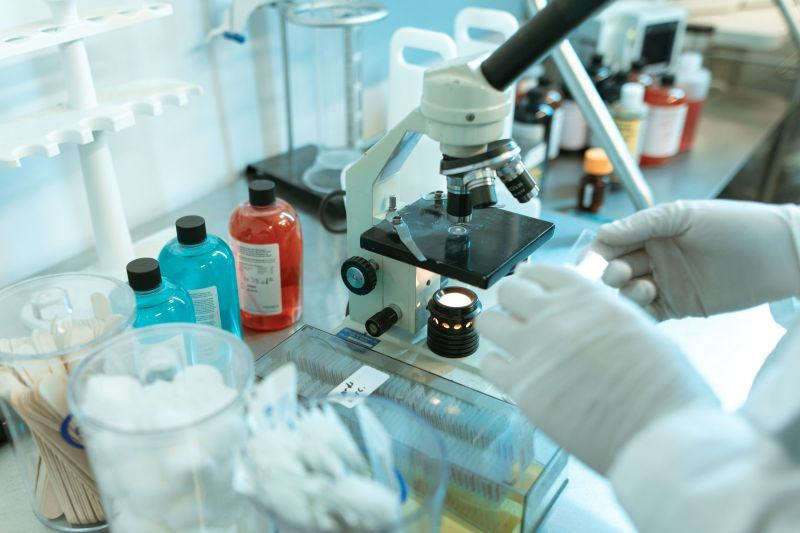
Laser Marking for Healthcare
Laser marking has become a critical technology in the healthcare and medical device industry. Stringent regulatory requirements, the need for permanent traceability, and the sensitivity of materials involved make laser marking the preferred solution for manufacturers of surgical instruments, implants, diagnostic devices, and laboratory consumables. Unlike traditional marking methods, such as inkjet printing, engraving, or labelling, laser marking produces permanent, chemical-free identifications directly on the substrate, with no consumables and no risk of contamination.
Why Choose Laser Marking in Healthcare?
Biocompatible markings
Laser marking modifies the surface of the material through a localized thermal or photochemical process, without adding inks, dyes, solvents, or adhesives. The result is a marking that is fully integrated into the substrate and does not introduce foreign substances that could compromise biocompatibility. This is particularly relevant for implantable devices, surgical tools, and components that come into direct or indirect contact with patients or biological samples. Marked surfaces comply with ISO 10993 requirements regarding biological evaluation of medical devices.
Sterilization resistance
Laser-marked identifications withstand all standard sterilization cycles used in clinical and industrial settings: steam autoclaving (up to 134 °C, repeated cycles), ethylene oxide (EtO), hydrogen peroxide plasma (H₂O₂), gamma irradiation, and chemical disinfection protocols. The marking does not fade, peel, or degrade under repeated sterilization exposure, ensuring that identification codes, serial numbers, and UDI data matrix codes remain legible throughout the entire service life of the device
Non-contact marking
The laser beam acts at a distance, with no mechanical contact between the marking head and the workpiece. This eliminates any risk of surface contamination, micro-deformation, or stress introduction, critical factors when working with thin-walled instruments, implants with tight dimensional tolerances, or fragile laboratory consumables such as histopathology cassettes and microscope slides. Non-contact processing also means no tool wear and consistent, repeatable results across production batches.
Medical standards compliance
Laser marking directly supports compliance with the main regulatory frameworks governing the medical device industry:
- EU MDR 2017/745 - requires Unique Device Identification (UDI) marking on all Class I, IIa, IIb, and III devices placed on the European market.
- FDA 21 CFR Part 830 - mandates UDI labelling for medical devices distributed in the United States.
- ISO 13485:2016 - quality management standard for medical device manufacturers; laser marking integrates into traceable, validated production processes.
- ISO 15223-1 - defines symbols used in medical device marking, many of which are applied via laser (CE mark, lot number, serial number, date of manufacture).
Laser-marked data matrix codes (ECC200) comply with ISO/IEC 16022 and can be verified to ANSI MH10.8.2 / ISO 15415 grading standards, ensuring reliable machine readability at every point in the supply chain.
Permanent and Tamper-Proof Traceability
Unlike printed labels or adhesive tags, a laser marking cannot be removed, replaced, or altered without visibly damaging the substrate. This is essential for anti-counterfeiting purposes and for maintaining an unbroken audit trail from manufacturing to end use. Each device can carry a unique identifier - serial number, data matrix, QR code, or 2D barcode - directly traceable to its production batch, raw material lot, and quality records.
High Precision on Small Surfaces
Medical components are often miniaturised: bone screws, endoscopic instruments, dental implants, catheter connectors. Laser systems with focused beam optics achieve marking areas as small as a few square millimetres with line widths below 50 µm, maintaining full readability of alphanumeric codes and machine-readable symbols even on curved or irregular geometries.
Multi-Material Compatibility
Fiber laser technology covers the majority of substrates in use across the medical device and laboratory sectors. High-contrast, permanent markings are achievable on stainless steel (AISI 316L), titanium alloys (Ti-6Al-4V), cobalt-chrome alloys, anodised aluminium, and high-performance engineering polymers such as PEEK and polypropylene - without altering the mechanical or chemical properties of the base material. On metallic surfaces, fiber laser annealing produces oxide-layer markings with no material removal, preserving surface integrity and corrosion resistance - particularly relevant for implants and reusable surgical instruments.
Applications of Laser Marking in Healthcare
M-Pix laser solutions are deployed across a wide range of applications in the medical and laboratory environment:
- UDI marking on medical devices: data matrix codes and serial numbers on Class I to III devices, compliant with EU MDR 2017/745 and FDA 21 CFR Part 830.
- Traceability of surgical instruments: permanent identification of scalpels, forceps, retractors, and other reusable instruments subject to repeated sterilization cycles.
- Marking of orthopaedic and dental implants: coding of hip and knee prostheses, spinal implants, dental screws, and abutments in titanium, cobalt-chrome, and stainless steel.
- Histopathology cassette identification: high-speed marking of tissue embedding cassettes with alphanumeric codes and barcodes for sample management and chain-of-custody tracking.
- Microscope slide coding: serial numbers, accession codes, and 2D barcodes on glass and polymer slides for anatomical pathology and cytology workflows.
- Endoscopic and minimally invasive instrument marking: coding on small-diameter components with curved surfaces, without affecting surface finish or dimensional tolerances.
- Laboratory consumables: identification of sample tubes, microplates, reagent containers, and diagnostic cartridges.
- Packaging and primary container coding: permanent lot, expiry, and batch information on aluminium foil, polymer films, and rigid trays, where ink migration into the product must be excluded.
Related Stories and Products
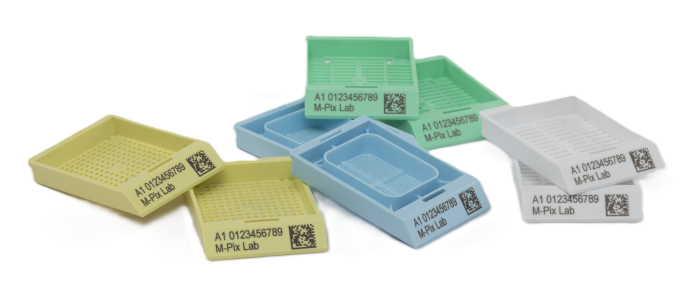
Story | Histology Cassettes
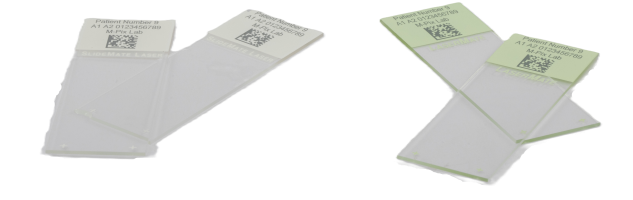
Story | Histology Slides
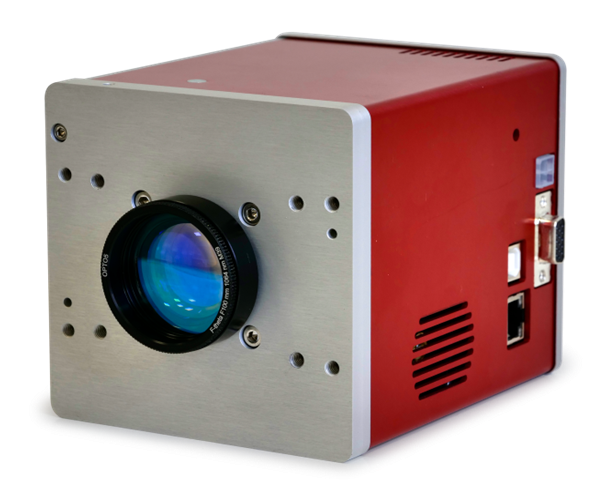
Product | MPK Laser Marker
FAQ
Yes. The laser modifies the surface of the material through a localised thermal or photochemical process, without adding inks, dyes, solvents or adhesives. The result is a marking that is integrated into the substrate and does not introduce any foreign substances, in accordance with the requirements of the ISO 10993 standard for the biological evaluation of medical devices.
Absolutely. Laser-marked identifications withstand all standard sterilisation cycles: steam autoclaving (up to 134 °C), ethylene oxide (EtO), hydrogen peroxide (H₂O₂) plasma, gamma irradiation and chemical disinfection. The marking does not fade, peel off or degrade, ensuring the legibility of UDI codes throughout the device's lifetime.
Yes, thanks to non-contact marking. The laser beam acts at a distance, eliminating any risk of contamination, micro-deformation or introduction of mechanical stresses. This is critical for thin-walled instruments, implants with tight dimensional tolerances, or fragile laboratory consumables such as histopathology cassettes and microscope slides.
Fiber laser technology covers the majority of substrates in use across the medical device and laboratory sectors. High-contrast, permanent markings are achievable on stainless steel (AISI 316L), titanium alloys (Ti-6Al-4V), cobalt-chrome alloys, anodised aluminium, and high-performance engineering polymers such as PEEK and polypropylene - without altering the mechanical or chemical properties of the base material. On metallic surfaces, fiber laser annealing produces oxide-layer markings with no material removal, preserving surface integrity and corrosion resistance - particularly relevant for implants and reusable surgical instruments.
Laser systems with focused beam optics achieve marking areas as small as a few square millimetres with line widths below 50 µm. This maintains full readability of alphanumeric codes and machine-readable symbols even on curved or irregular geometries, essential for orthopaedic, dental and endoscopic implants.
Yes. Unlike printed labels or adhesive tags, a laser marking cannot be removed, replaced, or altered without visibly damaging the substrate. Each device can carry a unique identifier - serial number, data matrix, QR code, or 2D barcode - directly traceable to its production batch, raw material lot, and quality records.
Contact Us
We specialize in tailor-made solutions for industrial laser markers, and we're looking forward to hearing all about your ambitious production projects.